




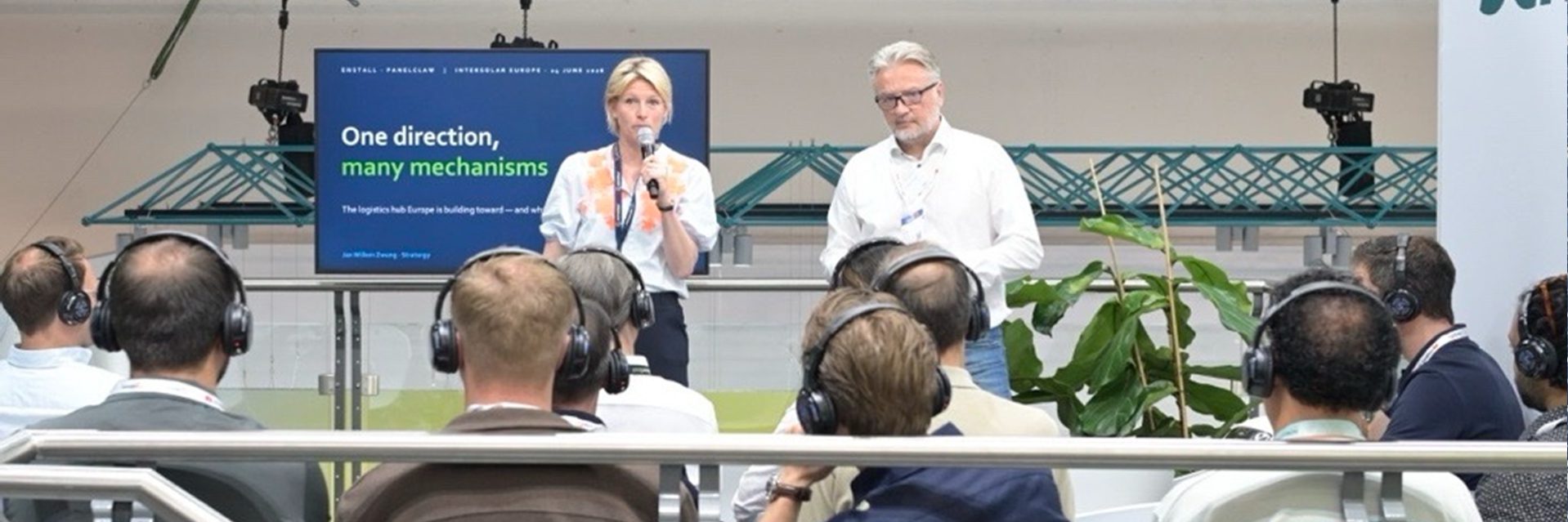
Interview with Jan Willem Zwang on Energy Infrastructure, Electrification and the Future of Commercial & Industrial Sites – Intersolar 2026
May 26 2026, Munich, Germany – Following his keynote address and panel appearance at Enstall’s Intersolar breakfast event, Jan Willem Zwang, founder of the Dutch consultancy Stratergy, shares his insights on why energy capacity is becoming one of the defining factors in commercial real estate.
For decades, commercial real estate was primarily evaluated through location, occupancy rates, rental income and asset quality. Today, another factor is rapidly moving to the centre of the conversation: energy capacity. As electrification accelerates across Europe, the ability of buildings to generate solar power, store energy and manage it intelligently is emerging as a key driver of long-term asset value.
In this interview, Jan Willem discusses how the energy transition is reshaping the real estate sector and what investors, developers and asset owners need to consider as buildings become increasingly dependent on reliable, flexible energy infrastructure.
– Jan Willem, during your keynote at Intersolar Europe, you argued that Europe is moving in one direction but through many different mechanisms. What do you mean by that?
Europe has a shared destination. We want cleaner transport, cleaner industry, greater electrification and a more resilient energy system. What differs from country to country is how we get there. Some markets rely on regulation, others on market incentives, grid pricing or carbon policies. The destination is shared, but the pathways are different.
– What challenges does that create for companies operating across Europe?
The biggest mistake is assuming that a successful solution in one market can simply be copied into another. Companies need to understand the long-term direction and then adapt their strategy to local realities.
– You also challenged the audience to rethink the role of commercial and industrial sites. Why?
Because most people still think about buildings as consumers of energy. Increasingly, that view is outdated. The next generation of logistics facilities, industrial sites and commercial campuses will support automation, robotics, digital operations and electric vehicle charging at a completely different scale than today. As a result, energy is becoming a strategic business requirement.
– So commercial real estate is becoming energy infrastructure?
Exactly. Historically, buildings were evaluated based on location, size and tenancy. In the future, energy capacity will become equally important. The question is no longer simply whether a building can host solar panels. The question is whether it can provide the energy flexibility required to support future business operations. That is why I believe commercial and industrial sites are evolving into energy hubs.
– One topic that attracted significant attention during your presentation was grid congestion. How serious is the situation?
Much more serious than many people realise. For years, businesses focused primarily on electricity prices. Increasingly, they need to focus on electricity availability. In many regions, access to energy capacity is becoming a limiting factor for expansion, automation projects and fleet electrification.
– What impact does that have on property owners and developers?
It changes the discussion completely. Rooftop solar, battery storage, charging infrastructure and intelligent energy management are no longer simply sustainability initiatives. They are becoming strategic infrastructure investments that enable future growth.
– What do you think commercial and industrial sites will look like in 2035?
I believe the most successful sites will function as integrated energy hubs. They will generate electricity, store it, manage it intelligently and deploy it strategically to support increasingly electrified operations. The organisations that succeed will not simply consume energy more efficiently. They will actively manage energy as part of their business strategy.
– What is the biggest opportunity that property owners are underestimating today?
The opportunity to transform energy from a cost factor into a value driver. As electrification accelerates, energy readiness will increasingly influence tenant attractiveness, operational resilience and long-term asset value.
– Finally, if you could leave property owners, developers and EPCs with one message, what would it be?
Start by asking how much solar generation your site can unlock. Then ask how that solar energy can be stored, managed and deployed to support future business operations. Competitive advantage will increasingly be determined by how effectively sites combine generation, storage and energy management.